
Discuss on Twitter
View Discussion


Where does the pouf end and Rio begin?

If there’s anything everyone can agree on, it’s that we often miss the nuances of things. Politics, social issues, momentum investing. It seems very black and white, all or nothing. And that’s not entirely a new thing—but it concerns me when it gets applied to individuals who we either lionize or vilify. In a world that’s increasingly complex, we should be increasingly nuanced. Instead, it often seems like we’re becoming less nuanced.
“You should never meet your heroes” is an adage that’s been around for quite a while. But it should go further.
In the film world, some of the most creative auteurs are huge assholes. They treat people like shit. In fact, it can go well beyond that as some of the #metoo saga has shown. It’s true in the classical music world, in the arts (painting, sculpture), and probably in every field. Gandhi, who brought freedom from tyranny to hundreds of millions of people and inspired MLK, participated in freakish experimentation in sexual stoicism.
In tech, the concept of heroes has long been a problem. Of course, there are amazing individuals who are pushing the world forward by being creative, bold, enterprising… by being geniuses in their field. The problem, though, is that we conflate capability or achievement in one sphere with everything else, including being a good person, a good human being, or someone who’s smart about everything else, like the arts. Why do we care what an accomplished CEO or investor thinks about all these other areas that they have nothing to do with? And more importantly, why do we give them the credence of a demigod?
It’s a truism that we only see a sliver of these people’s lives, and often, it’s the sliver they deliberately want us to see. If someone has the image of being infallible, that’s fiction. No one is flawless.
Whatever goes on a pedestal must come off. At minimum, it’s going to come down for cleaning. No pedestal is permanent. Putting people on pedestals doesn’t serve us, and it also doesn’t serve them, because it only makes things worse when they come crashing down.
There are so many smart people in the world. Some of the smartest people I’ve worked with are not even on social media. So they can’t become heroes in a world where followers, controversial hot takes, fragile egos, and pithy one-liners rule the world. My heroes are those who I know well, the people who I respect for their ethics and how they live their lives, not just their public accomplishments. But even then, I try to think of them as heroes in one sphere—in one part of life that I’m aware of.
In all film, but especially low-budget or independent film, there’s a saying that goes, “Put the money on the screen.”
It implies that creators will sacrifice things like their own fees, the quality of the accommodations, number of crew members, all in order to optimize for what the viewer sees – what’s eventually on the screen, the end product, the movie. They will, therefore, prioritize the best cast members, lighting, props, location – anything they believe will make the end product better.
The ultimate success is whether people love the film. No one is going to know if there were 2 or 3 grips, what kind of bottled water was provided on set, or what the creators went through. All the viewers judge is the final product and how the film makes them feel, whether the actors were superlative, the editing flawless, and whether it stays with them and makes an impression.
Startups are very much like indie filmmaking. There are many constraints, you cannot build everything you want, and you certainly cannot have everything you want. When sacrifices have to be made, how do you prioritize?
Your “screen,” as a startup CEO, is user experience. Many of you may be thinking about how to get through this pandemic and the resulting recession. Let’s use the principle of “put the money on the screen”. Your goal is to get as many people as possible to use your product, love your product, and talk about your product. User love means the NPS will be through the roof, and they can’t live without it.
To achieve that outcome, you need to have exceptional talent that is motivated by your mission and who can do more with less. User-focused product, design, and engineering folks. You will have to give up on a fancy office, free drinks, and more painfully, the expensive, but unproven product feature you’ve longed for since inception. You and the team may even have to take pay cuts to get through this time.
A director knows that a fantastic feature will set her on a path where she can finally start to control her own destiny – choose which projects she works on, have a crew that fits the vision, and not have to worry about endless fundraising cycles. The same is true for startups. Success, here traction and revenue, will allow you to control your destiny – decide how you want to grow the company, have a team that fits the vision, and be able to raise money (or not) to fulfill the goal. And that is the best outcome for any startup CEO.
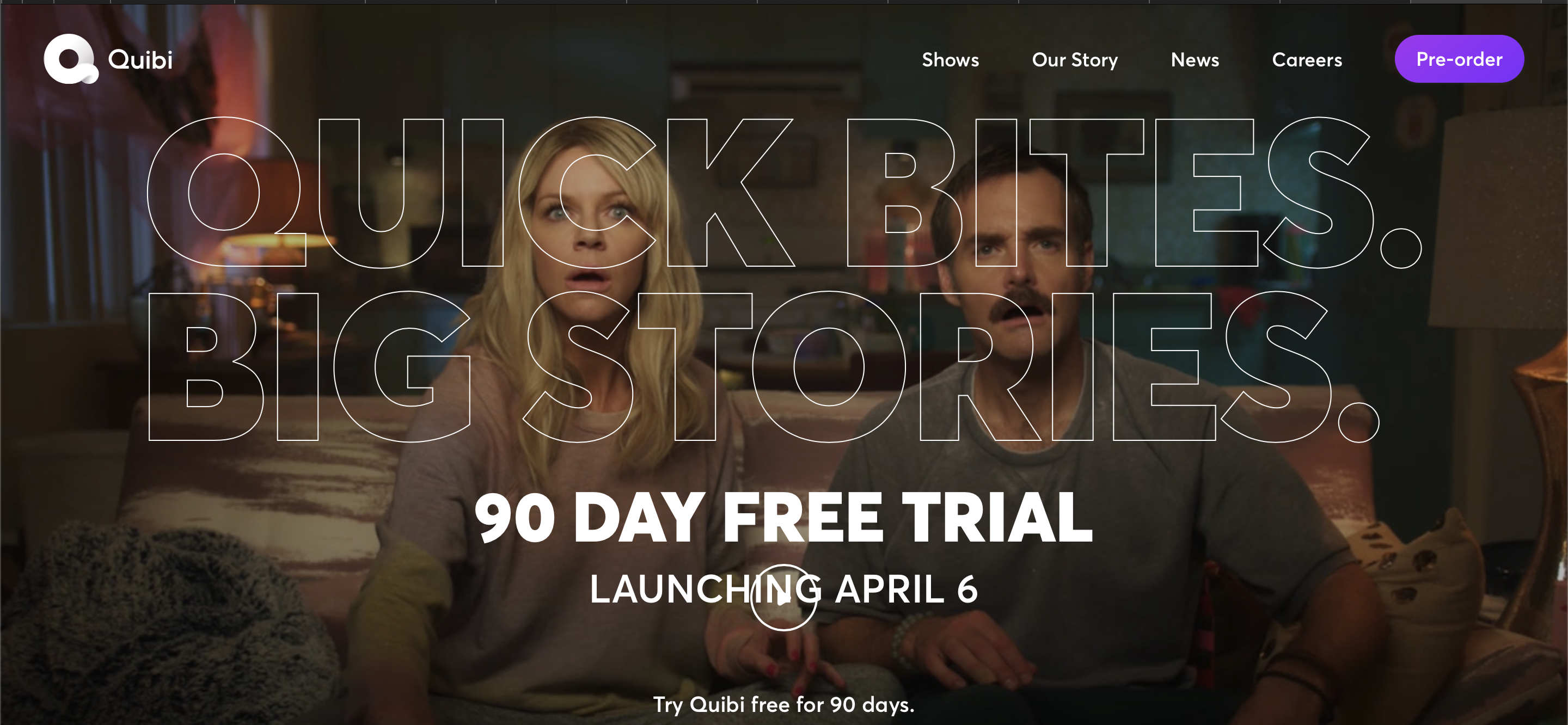
Quibi is a video streaming subscription service that will launch on April 6th. But it’s not “just another” streaming service. There are a few reasons Quibi is different. For one, they are the first service that is tailored specifically to the mobile phone. Led by Jeffrey Katzenberg, former Chairman of Disney, and Meg Whitman, former CEO of eBay and HP, they have raised close to $2 billion (with a “B”) before launch.
Quibi is getting a lot of snark and people seem genuinely stunned by the dollars at play. But I’d argue there was no other alternative. It was actually required. Quibi is a studio, much like Disney or 20th Century Fox, but unlike those studios that have built up their content libraries over decades, Quibi has built their entire library, from scratch, in the past 2 years. And they need to launch with this library available on day one.
There are two good reasons that they decided to build a whole, original library instead of licensing or acquiring existing content:
That’s why they need all of this money.
This is the first real innovation that has happened to movies since synced sound. And that is a very strong statement. Sure, technology has improved (frame rates, HD, 3D etc.), but whether we are watching it in a movie theater or on an iPhone, everyone’s experience is exactly the same: in landscape the whole time.
Quibi is finally leveraging the tech we now have (phones) to allow you to watch the movie differently. This might not seem like a big deal, but it opens up some very interesting possibilities. What if filmmakers used landscape for the “regular’ movie, and portrait…
— to watch it from the perspective of one actor?
— to show you what the characters were thinking instead of saying?
— to show you what was happening with another character or thread, in another part of the plot?
— to use a different language?
— to use no langue, but rather just silent, with everything in the facial subtext?
This is a real innovation in film and it’s really the first time that the technology we are watching the movie on, changes the movie we are watching. This has never happened before. Quibi has put constraints on itself – you can’t watch this on your television or laptop (although, I presume you can cast to them, the experience will not be as good). And by embracing constraints, it has opened itself up to creativity.
In addition, instead of being from 90-120 minutes, the movie is a set of chapters of 10 minutes. Each of those could be watched like an episode, instead of scrolling Twitter or Instagram.
This is not a regular startup. This is a movie studio plus a tech company. This is what they needed to do to give themselves a real shot. And yes, they are spending a ton on marketing. Again, what should they do? Spend a billion dollars on creating content no one sees? They are going big, they are able to raise that money, so I say, go for it.
Quibi is launching at an interesting time. We are all stuck at home during a global pandemic. This should work in their favor – who wouldn’t want a 10 minute break between the wall to wall zoom calls? Or at night while we try and decompress without a computer?
I love the fact that we are seeing innovation after centuries. It may change how movies are shot and give filmmakers a new way to speak to audiences. It’s exciting, it’s fresh, it could be huge.
I, for one, am rooting for them to succeed.

During my monthly women’s alumnae circle one of the participants raised the question on how to be an inspirational leader. Her manager was “incredibly inspirational” and she wanted to be seen that way, too.
“Inspirational” seemed to be this nebulous, possibly unattainable characteristic that was floating above us all… hard to achieve and only bestowed on the select few.
It forced me to think about inspiration. What is it? What does it mean, and is it some “secret skill” that some people are born with?
When I was young in my career, I, too, thought that inspiration was a sort of “magical power.” But the more I worked with inspirational leaders, the more I realized that it is often much simpler than that. It’s basically the same elements every time.
Whenever someone inspires you, this is what they’re doing:
They conceive of, and communicate, a big vision. They’re also able to articulate what the world will look like when this vision has been accomplished. Often, they are painting with a broad brush and using words that connect with you. By doing that, they show you how the world, or the company, or all of our lives will be better when this vision has been realized.
Then, they can explain why OUR team is the team that can make this happen. It may be hard, but we are the right ones, the capable ones, and goddammit, we will do it.
They break down the journey into digestible, logical chunks that will help the team execute. The BHAG (Big Hairy Audacious Goal) is broken down when they show you which stream of work YOU will own. This is where they make it clear you are valued and how your contribution is important to the goal.
Throughout the process, they motivate you to become the person who can accomplish the goal. You may hit roadblocks, because what we are trying to do is hard, but you are not alone, and they will help you become the person who can accomplish this.
Doing this well requires a base of trust. In the absence of a personal history together, they can say certain things to establish some kind of trust. Those things are basically:
If they succeed in their effort to inspire you, you become a motivated member of their squad. You are excited about the vision. You trust this leader knows how to get shit done, and get you from point A to point B. You also feel motivated to work your ass off to do your part, and if you hit a roadblock, you trust that the leader will help you solve it and support you in your efforts.
Finally, you believe you’ll be better off in the new vision, than in the current state of the world. That’s successful inspirational leadership.
These are the tangible actions that a good leader takes to be inspirational. What’s unsaid is that at the base of all this, the person has to be a good person, who genuinely cares about the people. As Jerry Colonna says, “I believe that better humans make better leaders.”

You’re a startup founder. You’ve gone through the rollercoaster, and things are going really well. Now you need to scale, because you’re overwhelmed with work, barely surviving.
Enter the “shiny-object savior.”
This person is [insert letter]VP at [insert big name company]. She seems to have it all – the titles, the accolades, the network, and could be the one (and only) person to actualize the company’s potential.
But there’s a risk that if they aren’t the right person for the job, they could significantly derail you both in terms of your milestones and in terms of your company’s culture.
Before you get starry-eyed, here’s the one question you should really ask yourself: Can they be successful in your company?
Here are the key factors to think about to answer this question.
They might not have accomplished anything meaningful/been successful.
Dig into accomplishments, not just the titles on the resume. A glossy resume could just be the result of their artfully job-hopping to make them seem like they are on an upward trajectory. Be wary of people who have never gotten a promotion within a company, as promotions are one sign of recognition for a job well done.
They might only function well within a certain culture.
Even if someone was able to get promoted or be successful at one company, they might be a great fit with that company culture—and only that culture. If that’s your culture, great. Hire them.
If the culture is different from what you are trying to build, be aware that they are going to bring elements of the old culture with them, because that’s the way they know how to thrive.
They might not have a growth mindset.
In my experience, successful startups need to be constantly learning, constantly ensuring product-market fit and constantly looking for new avenues of growth.
For a leader to thrive in an environment like this, they have to be able to navigate changes and know when to change course appropriately and when to stick to the plan. Have them tell you about a time when new data caused them to do something differently. Have them tell you about their world view, what has shaped it and how they think about changing that view.
Bottom line: Do not rush a big hire. Don’t get starry-eyed over a resume. Dig deep, know who they are, and do your references. The time spent upfront will significantly increase your chances of hiring the right person.